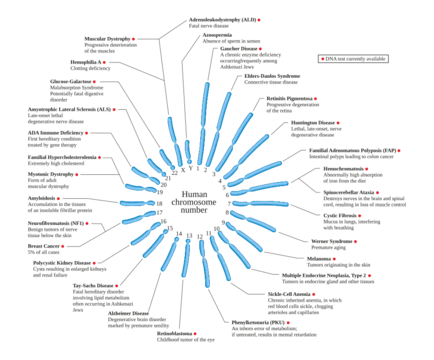
22q11.2 duplication syndrome
A rare genetic disorder with variable symptoms and frequent inheritance from normal parents.

22q11.2 duplication syndrome is a rare genetic condition that arises when a segment near the centromere on the long arm of chromosome 22 is duplicated. The most commonly reported symptoms include intellectual or learning disabilities (in 97% of cases), delayed psychomotor development (67%), growth retardation (63%), and low muscle tone (43%). However, these signs are fairly common and nonspecific reasons for genetic testing, and it remains unclear how much the duplication itself actually causes them. The duplication is often inherited from a parent who shows no obvious symptoms, which shows that normal intellectual development is possible.
Genetically, the duplications vary in size and which genes they include. The most common are a typical 3-megabase microduplication and a smaller 1.5-megabase nested duplication, both likely resulting from non-allelic homologous recombination using specific low-copy repeats. These microduplications are thought to be the reciprocal rearrangements of the better-known microdeletions in the same 22q11.2 region. Smaller duplications also occur within this highly dynamic area, using alternative low-copy repeats as recombination sites inside and beyond the DiGeorge syndrome region.
Unlike 22q11.2 deletion syndrome—where about 90% of cases are new mutations—most 22q11.2 duplications are inherited, often from a parent with a normal or near-normal appearance.
- field
- Medical genetics
- known_for
- Rare genetic disorder caused by duplication of 22q11.2 region
- symptoms
- Intellectual disability/learning disability (97%), delayed psychomotor development (67%), growth retardation (63%), muscular hypotonia (43%)
Lore & Background
The syndrome is caused by a duplication of a segment at the centromeric end of the long arm of chromosome 22. Duplications vary in size and gene content, including a typical common 3-Mb microduplication and a 1.5-Mb nested duplication, consistent with non-allelic homologous recombination using distinct low-copy repeats. These microduplications likely represent the predicted reciprocal rearrangements to the microdeletions characterized in the 22q11.2 region.
The most frequent reported symptoms include intellectual disability/learning disability (97% of patients), delayed psychomotor development (67%), growth retardation (63%), and muscular hypotonia (43%). However, these are common and relatively non-specific indications for cytogenetic analysis, and the extent to which the duplication causes these features is currently unknown. The duplication is frequently inherited from a normal parent, so it is clear that intellectual development can be normal.
The majority of 22q11 duplications are inherited, often from a parent with a normal or near-normal phenotype. This is in sharp distinction to 22q11 deletion syndrome, where about 90% of cases are caused by mutations that occur de novo.
Reader's Guide
22q11.2 duplication syndrome is significant as a rare genetic disorder that highlights the complexity of genotype-phenotype correlations. The condition is frequently inherited from a parent with a normal or near-normal phenotype, contrasting sharply with the 22q11 deletion syndrome, which is mostly de novo. This suggests that the duplication alone may not be sufficient to cause the observed symptoms, and other genetic or environmental factors may play a role. The variability in duplication size and gene content further complicates understanding. The syndrome's legacy lies in its contribution to the study of genomic rearrangements and the importance of careful genetic counseling, as many carriers of the duplication may have normal intellectual development.
Did You Know?
- The duplication is frequently inherited from a normal parent, so intellectual development can be normal.
- The most frequent reported symptom is intellectual disability/learning disability, occurring in 97% of patients.
- Duplications of 22q11 vary in size, including a typical 3-Mb microduplication and a 1.5-Mb nested duplication.
- The majority of 22q11 duplications are inherited, unlike 22q11 deletion syndrome where about 90% of cases are de novo.
Clinical Presentation and the Diagnostic Puzzle
The hallmark features reported in individuals carrying a 22q11.2 duplication include intellectual or learning disability, which appears in roughly 97 percent of affected patients, delayed psychomotor development at about 67 percent, growth retardation in 63 percent, and muscular hypotonia in 43 percent. While these figures paint a picture of a significant developmental burden, clinicians face a notable interpretive difficulty: each of these findings is relatively non-specific and can arise from many other genetic or environmental causes. The literature explicitly acknowledges that the precise contribution of the 22q11.2 duplication to each of these features remains uncertain. In other words, the duplication is a confirmed cytogenetic finding, but the causal chain linking the extra chromosomal material to a particular symptom is not fully mapped. This ambiguity means that the presence of these symptoms in a patient does not, by itself, confirm the duplication as the sole explanation, and conversely, the duplication does not guarantee a uniform clinical picture. The result is a diagnostic landscape where cytogenetic analysis is often prompted by common, overlapping indicators rather than a single pathognomonic sign.
Genetic Architecture and Recombination Mechanisms
The 22q11.2 region of chromosome 22 is a genomic hotspot characterized by frequent structural rearrangements, and the duplications found there come in multiple sizes with distinct gene content. The most commonly described form is a three-megabase microduplication, while a smaller 1.5-megabase nested duplication also occurs. Both are consistent with a mechanism called non-allelic homologous recombination, in which the cell uses different low-copy repeat sequences as recombination substrates to generate the extra copy. Importantly, these microduplications are widely regarded as the predicted reciprocal products of the microdeletions that define the well-known 22q11.2 deletion syndromes, meaning that the same recombination event that removes material in one individual can add material in another. Smaller duplications can also arise within and distal to the DiGeorge syndrome region, exploiting alternative low-copy repeats as templates. This layered architecture of nested and variable-sized rearrangements, all operating within a highly dynamic chromosomal neighborhood, explains why the clinical expression of 22q11.2 duplication is so heterogeneous and why no single gene dosage change accounts for the full spectrum of observed features.
Inheritance Patterns and the Parental Phenotype Puzzle
One of the most striking features distinguishing 22q11.2 duplication from its deletion counterpart is the pattern of inheritance. In the majority of documented cases, the extra chromosomal material is passed down from a parent who displays a normal or near-normal phenotype. This stands in sharp contrast to 22q11.2 deletion syndrome, where approximately 90 percent of cases arise from a new mutation occurring de novo in the affected child, with no prior family history. The fact that a carrier parent can be clinically unremarkable while their child presents with intellectual disability, growth retardation, or hypotonia raises important questions about penetrance, modifier genes, and the possibility that the duplication's effect is moderated by the rest of the genome. It also means that genetic counseling for families with a 22q11.2 duplication must account for the real possibility that the rearrangement has been silently present for generations before manifesting in a particular offspring. The duplication is not, in most cases, a brand-new event; it is a heritable variant whose clinical consequences depend on a complex interplay of dosage, background genetics, and possibly stochastic developmental factors.
Reciprocal Relationship to DiGeorge and Velocardiofacial Syndromes
The 22q11.2 duplication does not exist in isolation from the better-known deletion syndromes of the same chromosomal region. The microduplications are widely understood as the predicted reciprocal rearrangements to the microdeletions that cause DiGeorge syndrome and velocardiofacial syndrome, meaning they are, in a sense, the mirror image of the same recombination error. The duplication can occur within the DiGeorge syndrome region or distal to it, using alternative low-copy repeats as recombination substrates, which adds further complexity to the structural picture. Published case reports have documented familial instances of 22q11.2 duplication in which some clinical features overlap with those seen in DiGeorge and velocardiofacial presentations, blurring the boundary between the two conditions. This overlap is not surprising given that both syndromes involve the same cluster of genes on the long arm of chromosome 22, but in opposite dosage directions: one loses copies, the other gains them. The existence of this reciprocal relationship underscores that the 22q11.2 region is a structurally unstable genomic neighborhood where small changes in copy number can shift the clinical picture substantially, and where the same recombination machinery that produces a deletion in one family can produce a duplication in another.
Frequently Asked Questions
Who is 22q11.2 duplication syndrome?
It is a rare medical-genetics condition in which a stretch of DNA near the centromere on the long arm of chromosome 22 is copied one extra time. Think of it as the gain-of-material counterpart living in the same chromosomal neighborhood as the better-known 22q11.2 deletion syndrome.
What are 22q11.2 duplication syndrome's powers/role?
The most commonly reported features are intellectual or learning difficulties (about 97 % of cases), delayed motor and cognitive milestones (67 %), slower-than-expected growth (63 %), and reduced muscle tone (43 %). Because these signs are so widespread in the general population, experts still debate how directly the duplication itself drives them versus background genetic variation.
How does 22q11.2 duplication syndrome's story end?
There is no single fixed arc; clinical outcomes range widely from person to person. The duplication is frequently inherited from a parent who shows no visible symptoms at all, so the 'ending' can be anything from mild learning challenges to more pronounced developmental delays, with no guaranteed progression.
Why is 22q11.2 duplication syndrome important?
It exposes a central puzzle in copy-number-variant genetics: a small extra segment that produces a highly variable phenotype and is often carried silently by unaffected parents. Working through its variable expressivity helps researchers separate the true effect of the duplication from nonspecific developmental noise.
Where does 22q11.2 duplication syndrome come from?
The extra copy typically arises from a meiotic or mitotic error that duplicates a segment near the centromere of chromosome 22q. In many families the transmitting parent carries the same duplication yet displays no obvious clinical signs, making the inheritance pattern a recurring twist in clinical-genetics case reports.
More in Genetic anomalies 1-24
Spotted an error? Know more?
This is a living reference — every entry is fact-audited, and reader corrections feed straight into our audit queue. Suggest an edit · See this site's audit record